.avif)
Unlocking the Full Promise of Clean Slate: New Research on Automation and Opportunity
.avif)




Clean Slate laws are changing what second chances look like in America. When relief depends on navigating complex legal systems, paying fees, and filing petitions, the vast majority of eligible individuals never receive it, but Clean Slate changes that.
By automating record sealing, Clean Slate laws shift responsibility from individuals to the state, dramatically expanding access and removing long-standing barriers. A new study funded by The Clean Slate Initiative, Automating Administrative Burden in Algorithmic Criminal Record Expungement by Sarah Lageson, Ericka Adams, and Elsa Chen, offers one of the clearest pictures yet of what this transformation looks like in practice.
From Barriers to Access
Drawing on interviews with 105 people eligible for record sealing in California, New Jersey, Pennsylvania, and Utah, the study underscores just how inaccessible traditional petition-based systems have been.
Participants described processes that were confusing, time-consuming, and often prohibitively expensive. Even highly motivated individuals found themselves stuck, unsure which forms to complete, unable to access legal help, or discouraged by long wait times and uncertainty.
“I never actually tried to do anything because I was trying to figure out, you know, what paperwork do I need? Where do I file this? You know, who do I contact and I did actually contact the court, and then the court itself that I went to, and then they were not very helpful.” - Mark, New Jersey
“’cause you have to pay for each individual one, plus the filing fee, plus the record check. It was just like, they just kept on stacking everything up on everything it was. It was kind of ridiculous.” - Daniel, Utah
“It just felt lengthy, it felt like, I used this word before, but it's kind of like you're going for this gamble, where it's going to take a long time. It's not something that gets resolved within a week, it can take like, half a year to get resolved. In terms of like when, when you first start going through this process of expungement, to when the case wraps up. So it can take a long time. And those months can be very nerve wracking, like you're just wondering, like, is this going to work? Like, are there going to be any questions? Am I going to have to do anything else? Is there going to be any follow up? That can be really scary. It's like nerve wracking.” -Clara, Pennsylvania
For many, the process simply wasn’t worth the cost.
Automation fundamentally changes this equation. By eliminating the need to apply, pay, and navigate the courts, Clean Slate policies make record sealing accessible to people who may otherwise never receive it.
Participants in the study expressed support for automated sealing over petition-based systems, aligned with the idea that relief should not depend on resources, time, or legal knowledge.
“[the state] can do a better job for everybody to navigate them, you know, through the process and not have to go through the expense that, I mean, when you say Clean Slate law, I think it should be for everybody, you know, and accessible for everybody. And easy for everybody.” Charlene, Pennsylvania.
The Next Step: Making Relief Visible
As Clean Slate policies mature, the research highlights an important next phase: ensuring that people can fully realize the benefits of automation.
Because the process happens in the background, many individuals are unaware when their record has been sealed, or whether it has been sealed at all. Others remain unsure how to confirm their status or what it means for their future.
The study shows that when people are uncertain, they often proceed as if their record still exists, hesitating to apply for jobs, pursue new opportunities, or take risks that could improve their lives.
“....if I don't know that that barrier has been lifted, you know, I'm just going to proceed like it's there. So, if people don't know it, it can't really help them.” - Emma, Pennsylvania
“...It changes your life to know that you have a clean slate. It really does. …But it's good to know, I don't know. A person has to know, has to be made aware somehow.” -Donna, Pennsylvania
In this way, awareness becomes the bridge between policy and impact.
From Policy to Opportunity
Clean Slate is ultimately about expanding access to opportunity, especially in employment, housing, and education. This research sharpens an important insight: automation opens the door, but awareness helps people walk through it.
When individuals know their record has been sealed, and trust that it has, they are more likely to change their behavior in ways that drive economic mobility. They may apply for jobs they previously avoided. They pursue credentials, housing, and new pathways forward.
“I just feel like there's a lot of layers of communication. And not a lot of that information ends up getting down to the people who need it. It doesn't feel accessible.” -Mark, New Jersey
Without that clarity, the benefits of record sealing can remain just out of reach.
At The Clean Slate Initiative, this is exactly where the work is focused: ensuring that strong policies are paired with strong implementation.
Across states, CSI is working with partners to expand notification and awareness, improve transparency, and ensure individuals can easily confirm their record status. This includes advancing strategies that provide clear communication when records are sealed, supporting tools that help people verify their eligibility and status, and strengthening policy design so that implementation is as accessible as the law itself.
This work reflects a simple but powerful goal: not just sealing records, but ensuring people can fully benefit from that change.
By removing barriers and shifting administrative burden to the state, Clean Slate laws are expanding access to second chances at a scale that was previously unimaginable. At the same time, the research points to the opportunity ahead.
That is the next chapter of this work, and one that CSI is actively building toward every day.
New Research: The Economic Losses from Arrest & Conviction Records
A new research report by The Clean Slate Initiative finds that arrest and conviction records are associated with substantial and persistent losses in employment and earnings — even when a person was never convicted and even after more than a decade without further legal system contact.
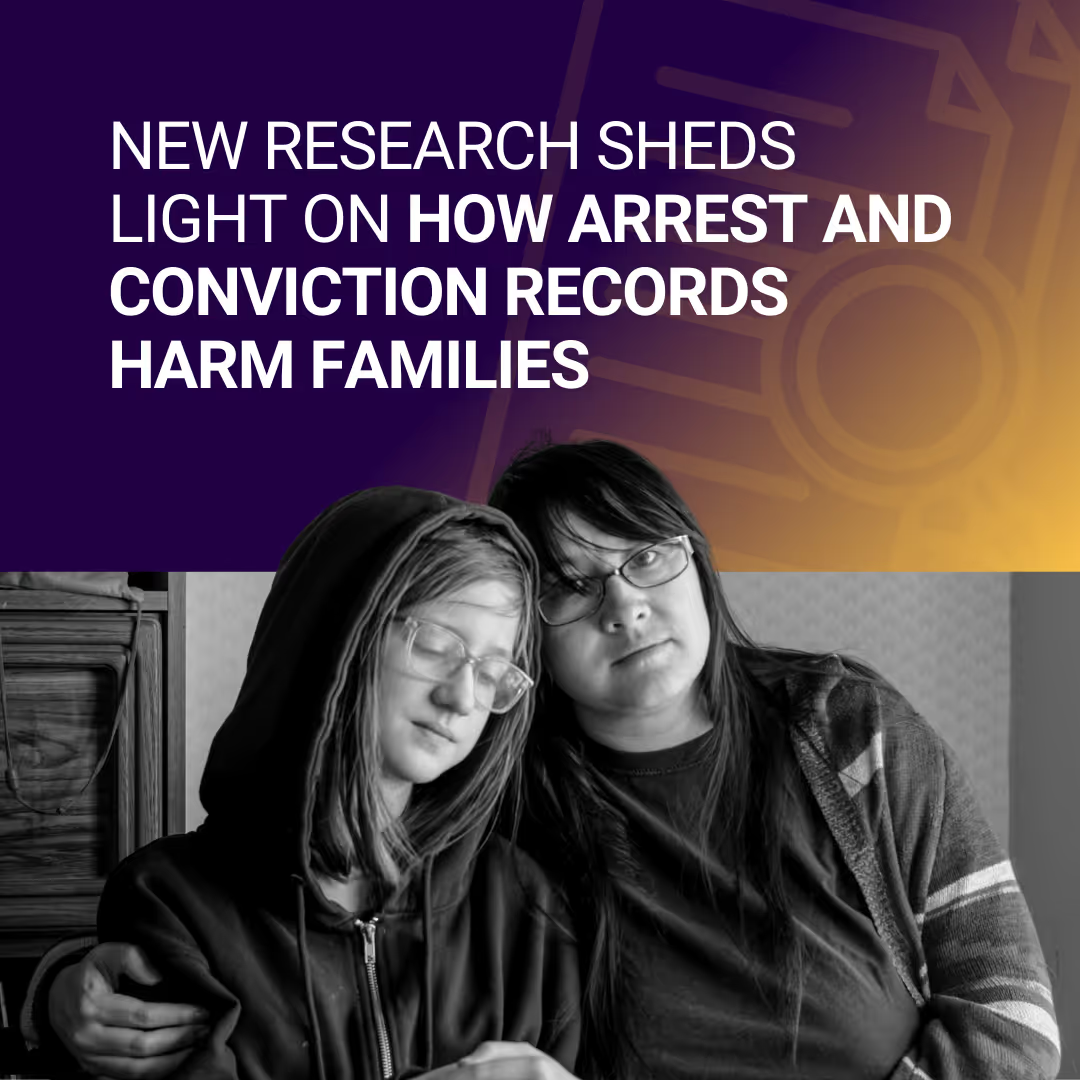
New Research Sheds Light on How Arrest and Conviction Records Harm Families
An old arrest or conviction record doesn’t just impact the person who has it; it can entirely reshape family life — known as symbiotic harms. New research funded by The Clean Slate Initiative explores that ripple effect. Learn more in this update from Dr. Laura Chavez, CSI; Ericka B. Adams, San José State University; Elsa Y. Chen, Santa Clara University; and Sarah E. Lageson, Northeastern University School of Criminology and Criminal Justice and School of Law.

New Research Shows Automated Sealing for Non-Conviction Records Works — With Room for Improvement
A new study published in the North Carolina Law Review — funded by The Clean Slate Initiative and led by Professor Colleen Chien of UC Berkeley — is the first large-scale look at how well those automated systems are working to remove barriers for people with non-conviction records. Learn more in this update from Dr. Laura Chavez, Director of Research & Data.
Virginia’s Clean Slate Implementation Started This July: Here’s What You Need to Know
Virginia's Clean Slate Act entered implementation on July 1, 2026. Learn what changed, who may be eligible for record sealing, and what comes next as the law rolls out across the Commonwealth.
New Research: The Economic Losses from Arrest & Conviction Records
A new research report by The Clean Slate Initiative finds that arrest and conviction records are associated with substantial and persistent losses in employment and earnings — even when a person was never convicted and even after more than a decade without further legal system contact.
.png)
New Resource Helps Pennsylvanians Understand Clean Slate and Check Their Records
A new Clean Slate Initiative resource helps Pennsylvanians understand which records may qualify for automated sealing, how waiting periods work, and how to check what appears on their public record.
